

enpl

Michał Gold

Birthday
30.11.1999
City
Gliwice, Poland
Tel.
507 894 996
E-mail
GitHub
More extensive portfolio can be found over on https://gold.bieda.it/en

About me

Programming enthusiast - mainly C++ and JavaScript (completely unrelated languages, but that's how it turned out).
My first contact with programming was in middle school, and I've been writing code ever since.
I treat programming as a very complex logical puzzle (and I love logical puzzles).
From time to time I solve tasks related to algorithmics, on sites such as CodeWars [my profile] and (since recently) CodeForces [my profile].
I also find Maths to be very fun.

I also had a lot to do with FPGA's and SystemVerilog, which were the core of my Bachelor's and Master's thesis.
I also created several smaller projects using Arduino and ESP32.

Diligent student - mostly A's, both in high school and university:)

I like to learn (in my free time I like to watch e.g. recordings from CppCon conferences; I follow several blogs about programming).
I am willing to learn any technology if it is required of me. I am not afraid to read documentation.

On the more non-engineering side: I'm loosely interested in linguistics and Japanese culture.

Skills

  • Known programming languages:
    • advanced: C/C++, JavaScript (Vanilla, NodeJS, Vue), SystemVerilog
    • basic: Python, C#, Rust (Tauri framework)
  • Experience working with FPGA and various EDA tools (Quartus, Questa, VCS, Verdi, FusionCompiler)
  • Programming micro-controllers (Arduino, ESP9266, ESP32)
  • Familiarity with GIT
  • Familiarity with Matlab
  • Familiarity with relational databases - especially SQLite
  • Basic knowledge of programming PLCs and industrial robots
  • Native language - Polish
  • Advanced knowledge of English

Education

1.10.2019 - 22.02.2023 (7 semesters)
Silesian University of Technology — major "Automatic Control & Robotics" | Bachelor's
Average total grade: 4,79 | Thesis grade: 4,75
1.05.2023 - 8.07.2024 (3 semesters)
Silesian University of Technology — major "Microinformatics of Embedded Systems" | Master's
Average total grade: 4,92 | Thesis grade: 5

Certificates & Achievements

13.11.2020 - 15.11.2020
AI HACKATHON skyhacks 2020 | Competition, 4-person team
3rd place, 4000zł price won
November 2022 - February 2023, at Silesian University of Technology in Gliwice
Introduction to PCB Design Certification Course | Course by Siemens
Certificate of completion

Work Experience

18.04.2017 - 18.05.2017 (1 month)
GONG Creative Agency
Internship as Front-End Developer
11.07.2022 - 11.07.2022 (1 month)
I-CON
Internship as PLC and Industrial Robot programmer

My Projects
Collapse all...

Branch Prediction Module for a RISC-V processor

Master's thesis

FPGA, SystemVerilog, QuestaSim, RISC-V, ASM, C, NodeJS, HTML, Makefile
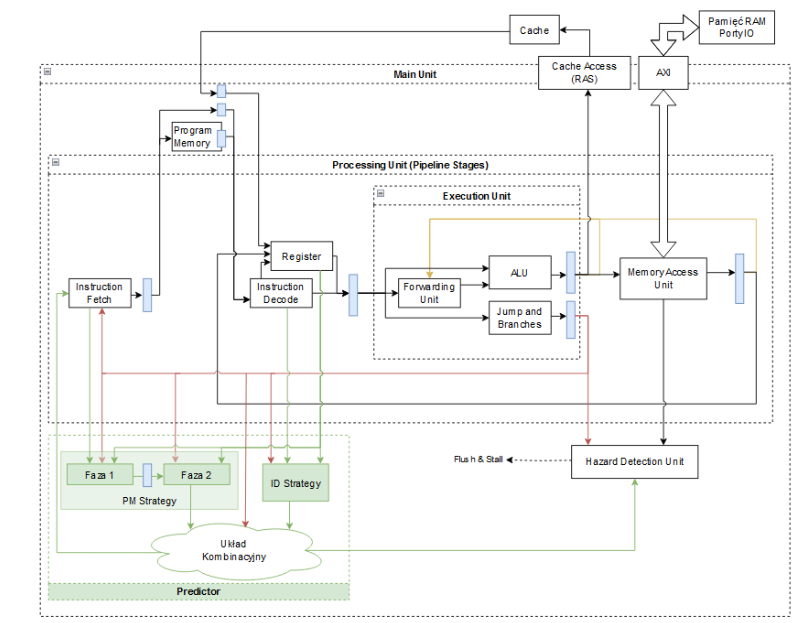
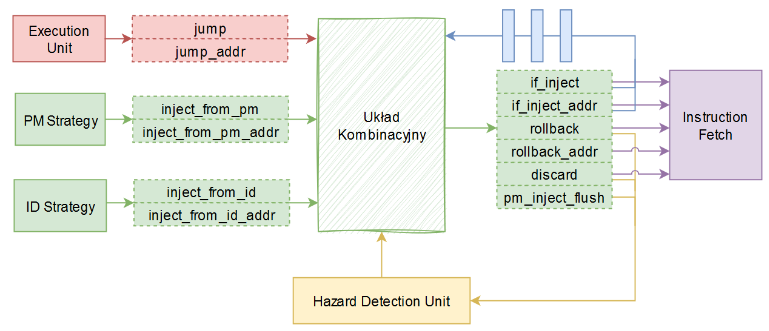
The aim of the thesis was to design, implement, test, and study the efficiency of a branch prediction module for a microprocessor based on the RISC‑V specification.
Show less...
The module was integrated with an already existing RISC‑V CPU project, created as part of other master's theses, by other students.

I devoted a significant part of my work not only to creating the predictor, but also to analyzing and repairing the RISC‑V processor project, because it turned out to be full of errors and inconsistencies with the provided documentation.

In addition to the predictor itself, an extensive test environment was created, allowing for fully automated programs compilation, running simulations, and creating reports. The environment consists of scripts (written in JavaScript) and a Makefile file, allowing for the selection of configuration, with which variant of the predictor the project should be compiled, and which test programs to run.

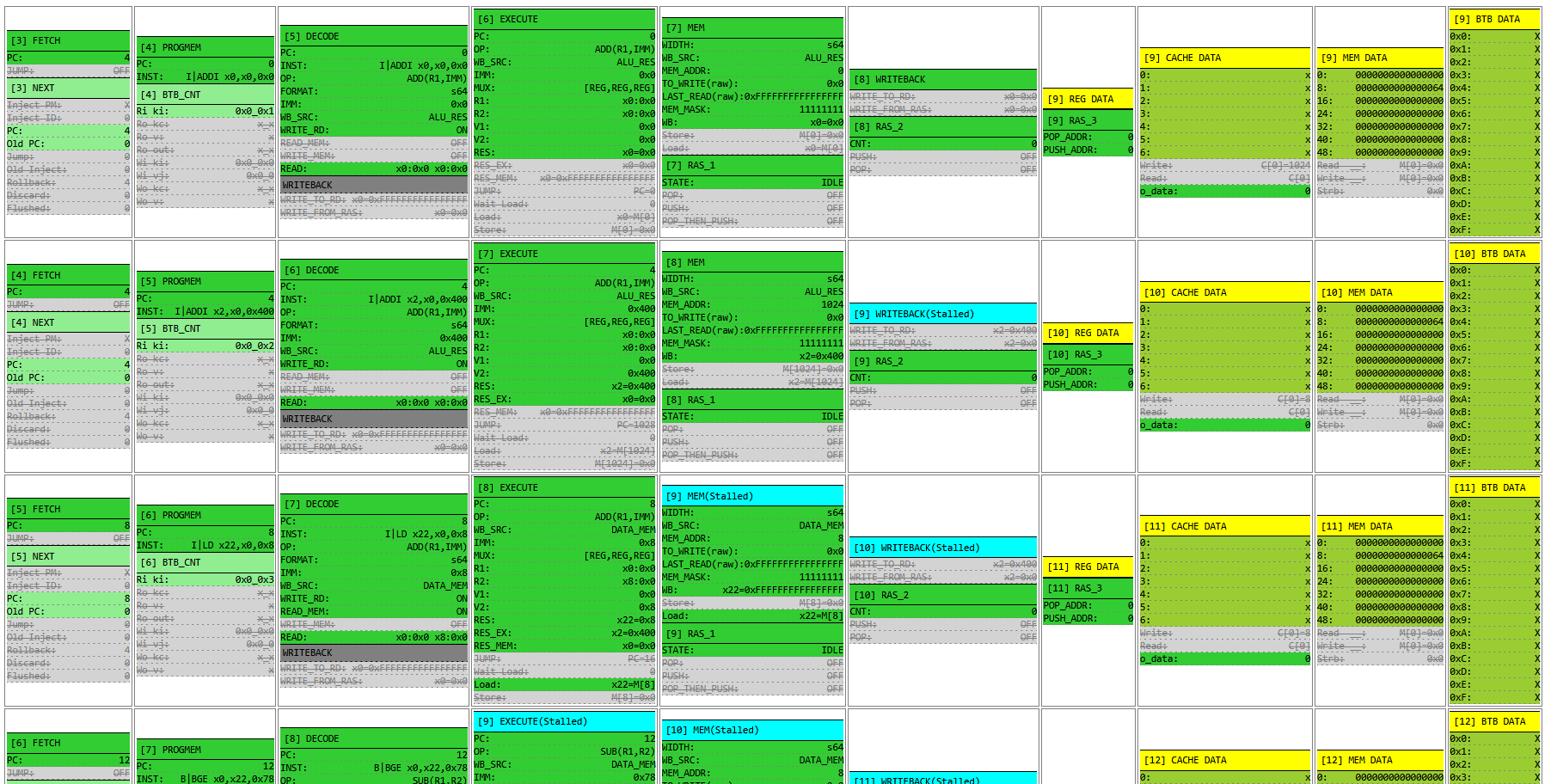
Additionally, an visualizer of processor internal signals was created, presenting an insight into its operation using an HTML file, divided into cycles and pipeline stages.

A more detailed description of the project structure, and how could you run the project yourself, is over in GitHub's readme.

Show less...

Master Mind video game on a FPGA

Bachelor's thesis

FPGA, SystemVerilog, QuestaSim, Quartus, VGA, HDMI, Breadboard
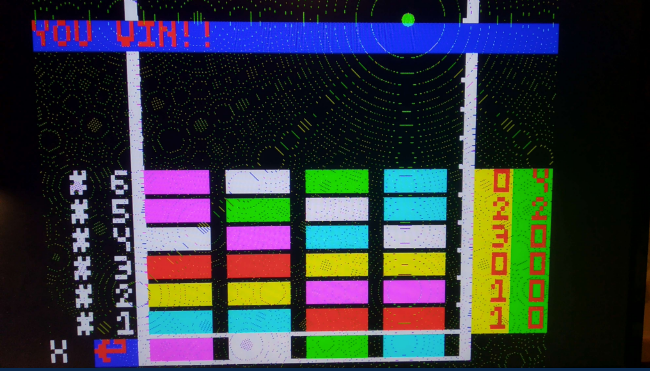
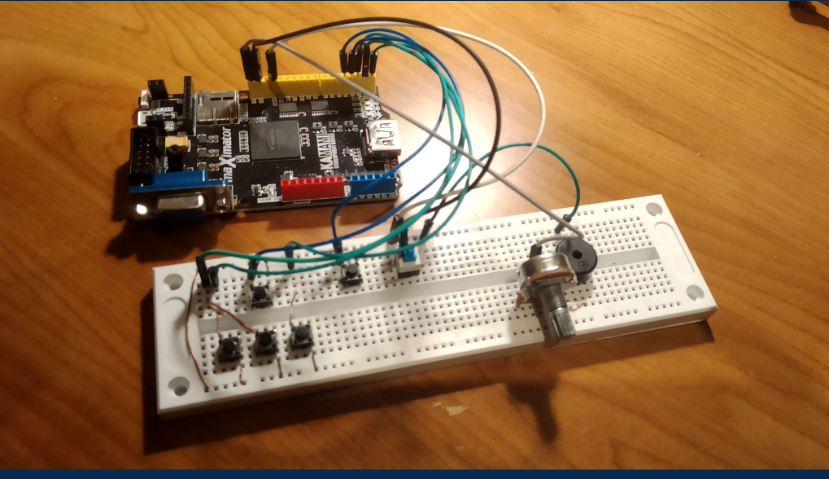
The aim of the thesis was to design and create the logic game "Master Mind" based on a FPGA system. The device is controlled using buttons on the breadboard, and the image is displayed using VGA or HDMI.
Show less...
The Master Mind game consists of guessing a certain sequence of colors (set randomly by the device or by another player). With each guess, the device determines and displays hints as to how many colors are correct and how many of them are in the correct position.

The game was created entirely in the hardware description language SystemVerilog. This approach requires a different way of thinking than in the case of programming in a regular programming language (such as C++). Since the entire logic was designed in hardware, it was not possible to simply define a sequence of instructions to be executed - there is no processor to execute them. Data is processed much more concurrently than if a CPU were used, which required some creativity, especially when implementing the logic calculating the hints.

The designed system displays the game image on a monitor with a VGA and/or HDMI interface. Control is performed via buttons on a separate breadboard connected to the device. The project is also equipped with a speaker that can play simple melodies. The user is able to configure many game parameters, such as the number of available colors, the size of the board and the number of allowed attempts to guess the hidden sequence. It is also possible to set the size of the font displayed on the screen and the color palette used to draw many elements.

Show less...

Laboratory station with the educational robot ASTORINO

PBL Project

ESP, RaspberryPi, I2C, MQTT, ModbusTCP, C++, NodeJS, Robot, PLC, Breadboard
PBL (project based learning) is an alternative type of university classes, where a group of students are assigned a complex project to create over the course of the semester.
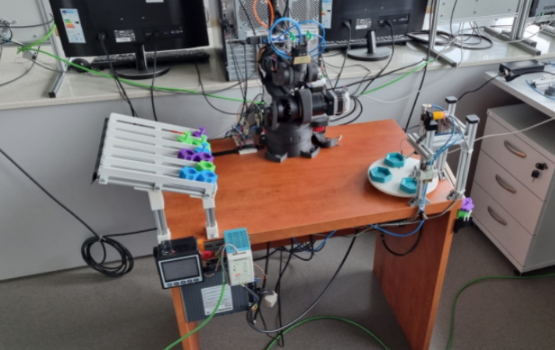
The goal of the project was to create a station with the ASTORINO educational robot, to showcase it's capabilities. The group consisted of 6 students, with me as the de-facto leader. My task was to create the HTTP interface on RaspberryPi, software for the robot, and the ESP8266 for managing robot's IO
Show less...
The station consists of:
  • ASTORINO robot
  • ESP8266 (for interfacing between the robot and other components)
  • HTTP control interface (on a RaspberryPi)
  • Storage structure from aluminum profiles
  • Collection of multicolored 3d-printed elements (bases and tops)
  • Small rotary table, controlled by a PLC
  • Collection of sensors (camera, distance, force and induction)
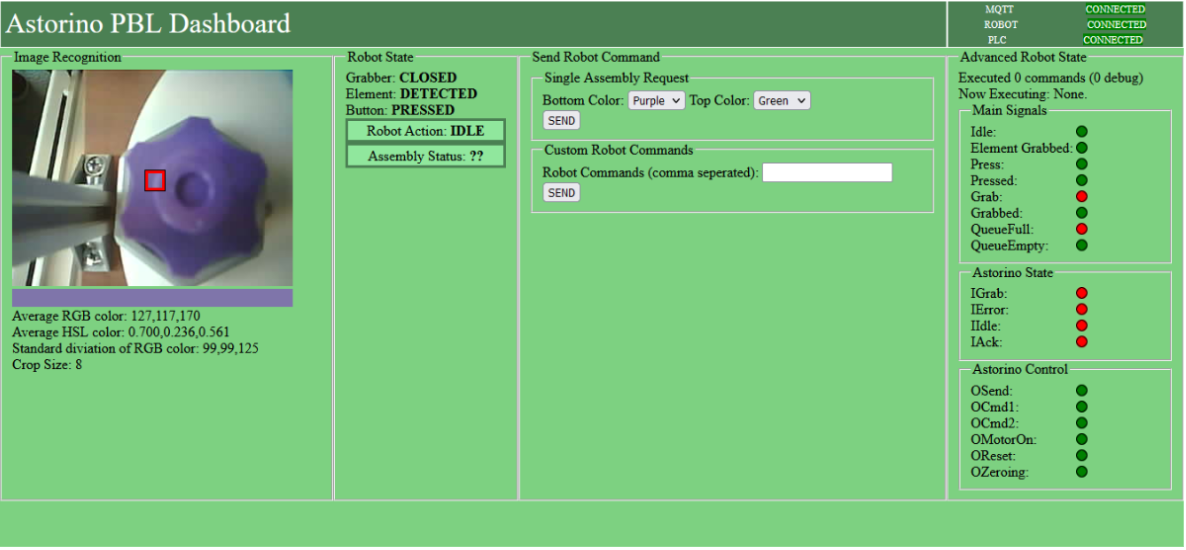
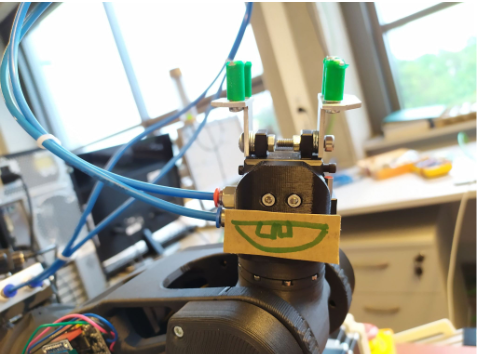
The station operates as follows: The user creates a request via the HTTP interface, to produce an element with parts of 2 specified colors. Then, the robot grabs the parts from the corresponding rails and inspects them with a distance sensor. The parts are put on the rotary table, and their color is checked by the camera. The robot screws the two parts together, and then outputs the complete element on the output rail (or throws the parts into the trash, if sensor inspection was negative).

Throughout the entire process, the user can preview the state of sensors and internal signals in the HTTP interface.

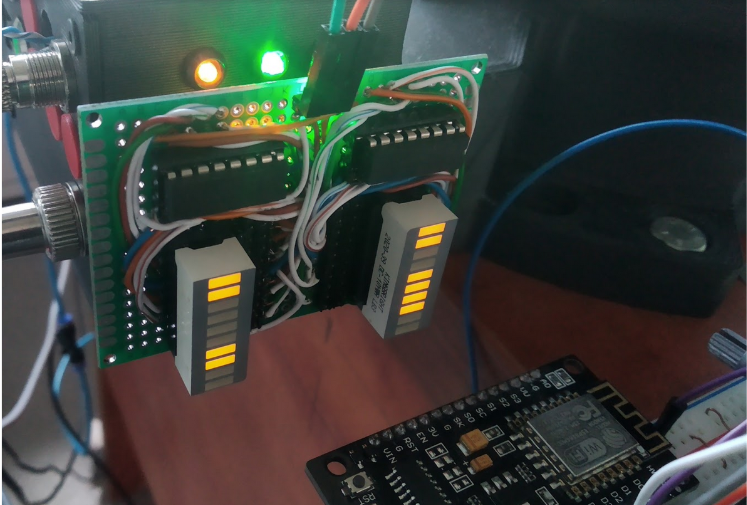
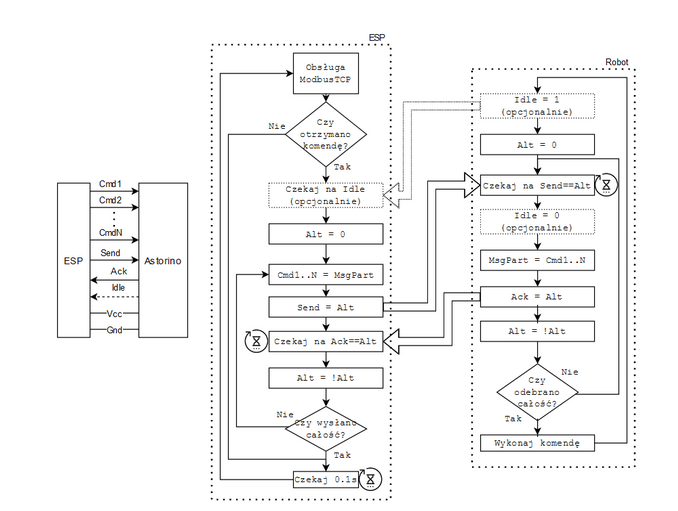
The robot communicates with ESP via the General Purpose Input and Output ports. Because ESP has too few of those, to fully implement state preview and reliable communication, it was required to use additional port extenders, on a I2C bus. The communication is done via a custom made handshaking protocol. The robot has a precoded set of possible actions, which are send serially from the ESP.

The communication with other components (RaspberryPi and camera) is done via MQTT protocol over WiFi. The RaspberryPi acts as a MQTT Broker. The PLC controlling the rotary table had to be controlled via ModbusTCP.

The ASTORINO robot used in the project was still in the alpha development stage. It made it so that, a lot of things were breaking all the time. For example, the most "fun" thing we encountered, was the robot reading an input pin as the inverse of it's actual state, once every 10000 or so polls, which led to out of nowhere ramming into the table :).

Show less...

Database Management App for a car workshop

Database, SQLite, Tauri, Rust, JavaScript, Vue, PDF generation, Migration from MSAccess
My first commercially used product.
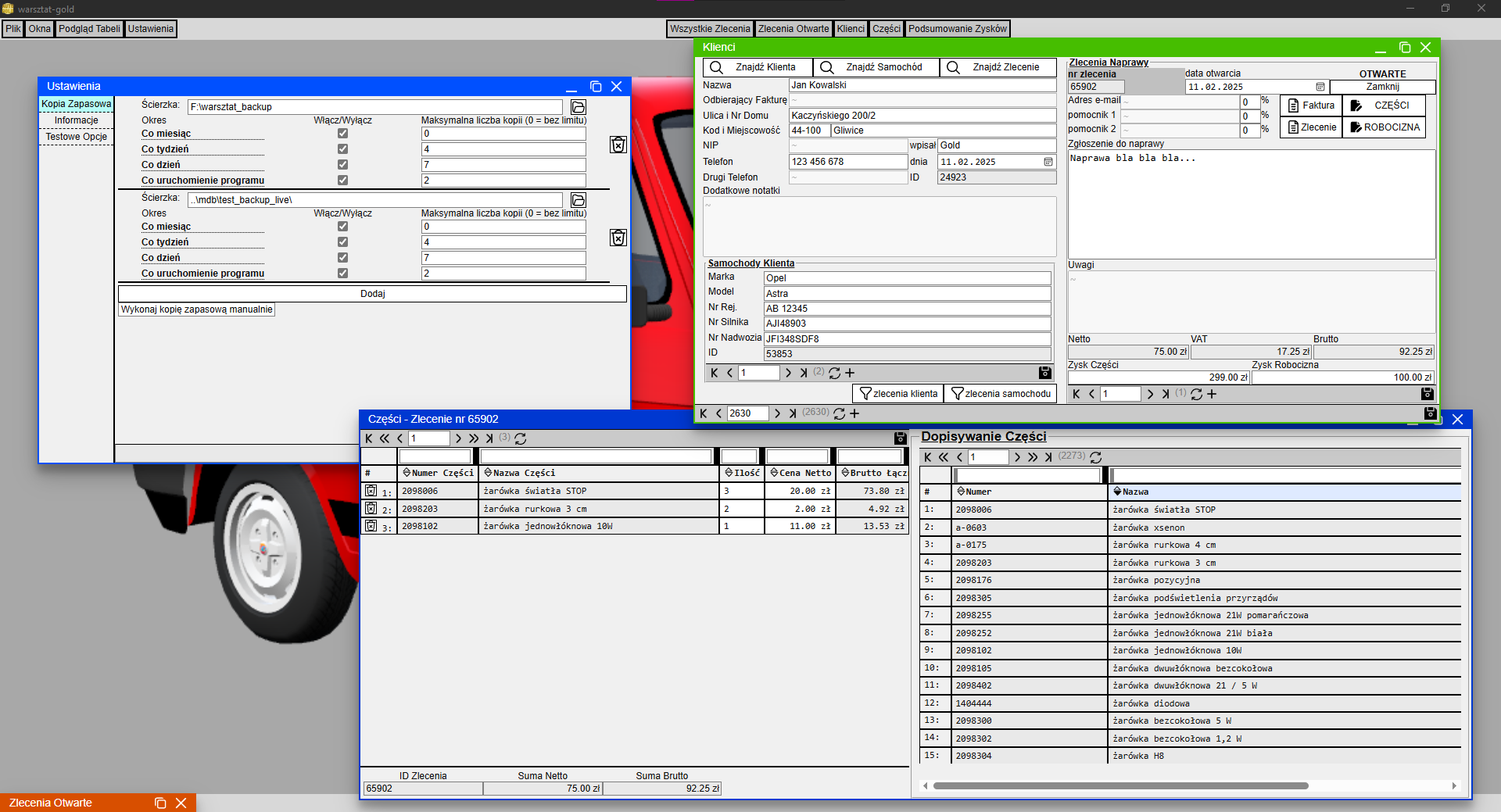
One of my relatives was using an old Microsoft Access 97 (!) database at their company. My app was made to replace it. App allows for managing customers, orders, and car parts, easy migration (to and from) MS Access 97, and performing automatic backups
Show less...
The original application in MS Access was ridden with custom macros, that made it impossible to simply import it to a newer version of Access, and had to be run on a Windows XP virtual machine, and was unwieldy to use altogether.
I decided to build a new app from the ground up. It made it much simpler to add new custom features, than if I were to use another Access-like program. I opted for the SQLite database for the backend.

The app was created with the Tauri framework. Tauri allows to use the operating system's built-in WebViewAPI, which enables my app to use all the features as a Web Browser (most importantly HTML, CSS, and JS for layouts), while not bundling an entire NodeJS runtime, like with Electron.

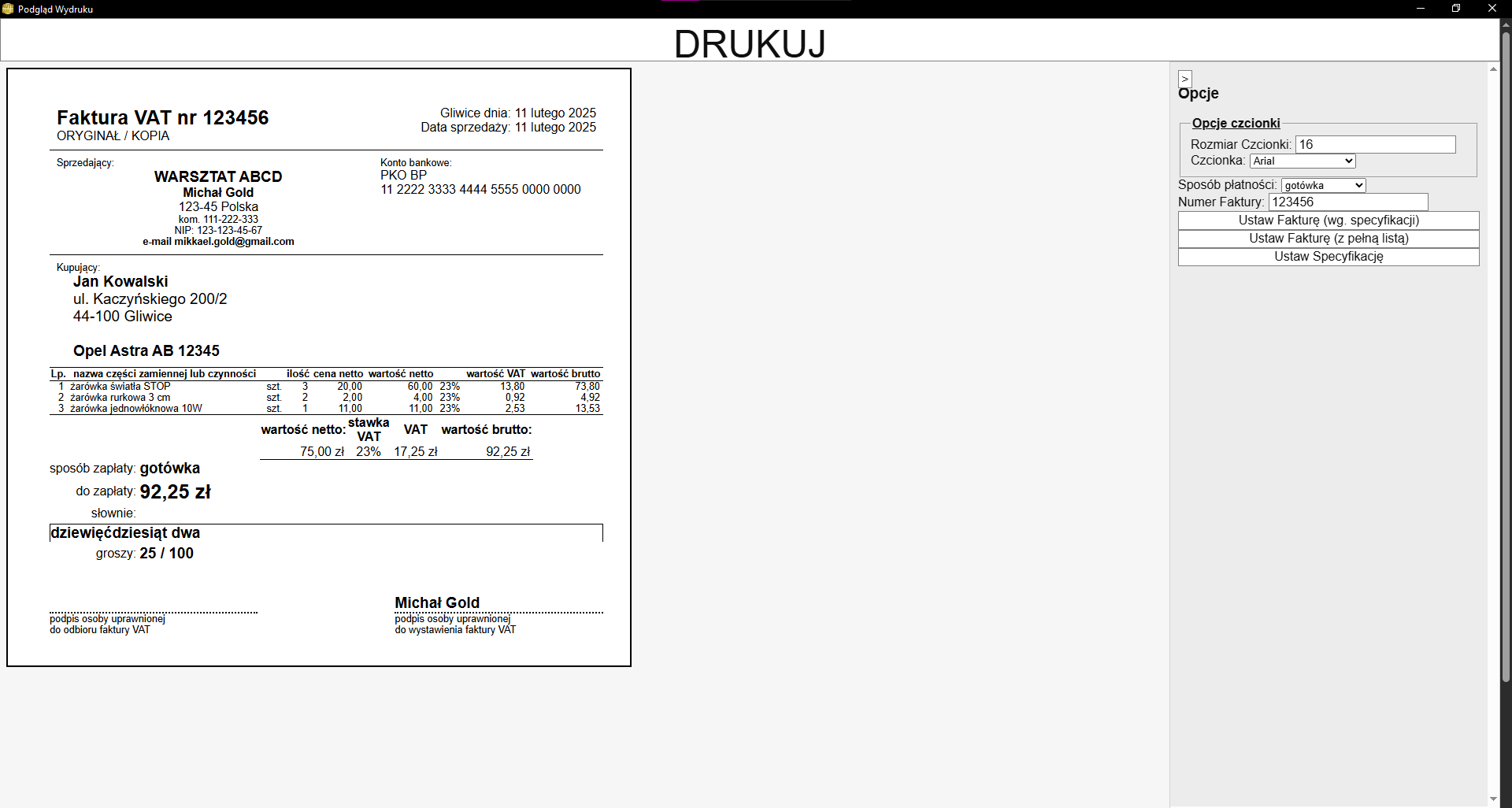
Tauri's backend is written in Rust. All the interfacing with the SQLite and managing the files is handled by Rust. The user interface is created with the use of the Vue framework. The user can add and edit clients, registered cars, car parts, and orders. They can also filter the views based on many parameters. For each order, an invoice's PDF can be generated and printed automatically.

As a safety net, my app is able to import and export its current state to or from the original MS Access app, using CSV files as intermediate. I also created a couple of scripts in NodeJS, which help to convert the original MS Access db structure into a SQLite one. The app also performs regular configurable backups of the database.

Show less...